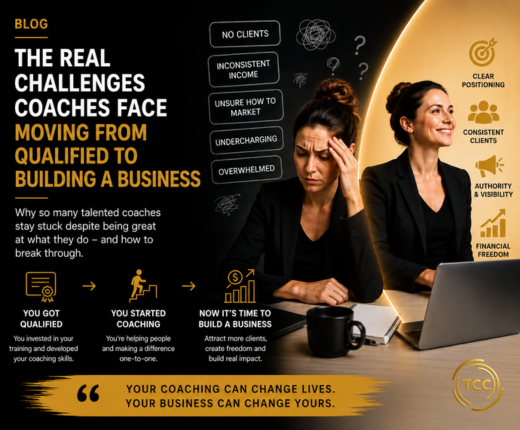
Qualified as a Coach. Now How Do You Actually Find Clients and Build a Business?
Getting qualified as a coach is a huge achievement. You’ve invested the time, completed the training, practised your coaching skills and reached the point where you’re ready to start helping people.
Then comes the question that catches a lot of newly qualified coaches out.
Where do the clients actually come from?
It’s one of the biggest gaps we see in the coaching industry. There is rightly a huge amount of focus on teaching people how to become good coaches, but considerably less attention is given to teaching them how to turn those skills into a commercially sustainable coaching business.
Knowing how to coach and knowing how to build a coaching business are two very different skill sets. If you want to create consistent income from coaching, you need both.
Your Qualification Is the Beginning, Not the Business
A coaching qualification gives you the foundations to work effectively with clients. It doesn’t automatically give you a pipeline of people who want to work with you.
Once you decide to build a business around your coaching, you suddenly need to think about positioning, marketing, lead generation, sales, pricing, referrals, content and building relationships.
For many coaches, that can feel uncomfortable. They didn’t become a coach because they wanted to become a salesperson or spend every day trying to understand social media algorithms.
But building the commercial side of your coaching practice doesn’t mean becoming somebody you’re not.
It means developing a simple and repeatable way of helping the right people understand who you are, what you do and why working with you could help them.
Start With Who You Actually Help
One of the first challenges for many coaches is positioning.
Ask a new coach who they help and you’ll often hear something along the lines of, “I can coach anyone.”
Technically, that might be true. Commercially, it makes building a business considerably harder.
If everybody is your potential client, your message usually becomes so broad that nobody immediately recognises themselves in it.
You don’t necessarily need an incredibly narrow niche, but people should be able to understand what you do.
Who do you enjoy working with? What situations are those people typically dealing with? What problems bring them to a coach? What outcomes are they trying to achieve?
The clearer you become about those questions, the easier everything else becomes. Your content gets easier to create, your conversations become more relevant and potential clients are much more likely to understand why they should speak to you.
You Need Conversations, Not Just Followers
Social media can be incredibly useful for coaches, but having an audience isn’t the same thing as having a business.
You can have thousands of LinkedIn followers and very few clients. Equally, you can have a relatively small network and build a successful coaching practice because you consistently have the right conversations.
The goal of your marketing shouldn’t simply be to collect likes, views and followers. It should create opportunities for conversations with people who could genuinely benefit from what you do.
That might come through LinkedIn, networking, referrals, partnerships, workshops, events, email, your existing professional network or a combination of several channels.
You don’t need to be everywhere.
You need a small number of activities you can consistently execute and a clear understanding of how those activities eventually lead to conversations.
Lead Generation Has to Become Part of the Job
One of the easiest traps to fall into when building a coaching business is only focusing on lead generation when you need a client.
A coach finishes working with somebody, realises there is suddenly a gap in their diary and immediately starts posting more often, attending networking events and messaging contacts.
Then a new client arrives and all of that activity stops.
A few weeks later, the cycle starts again.
That makes building consistent income incredibly difficult.
Lead generation works much better when it becomes part of your normal weekly activity. You should be building relationships and creating future opportunities even when your diary is relatively busy.
It doesn’t need to consume your week. A few hours of structured, consistent commercial activity can make an enormous difference compared with bursts of activity whenever the pipeline runs dry.
Selling Coaching Doesn’t Have to Feel Like Selling
Sales is one of the areas coaches often struggle with most.
For some, even the word feels uncomfortable.
The good news is that selling coaching shouldn’t involve pressuring somebody into buying something they don’t need.
A good sales conversation actually has a lot in common with coaching.
You ask questions.
You listen.
You understand what’s happening.
You explore what the person wants to change.
You identify the gap between where they are and where they want to be.
Then you decide whether what you offer can genuinely help them.
If it can, explain how.
If it can’t, don’t sell it.
The problem usually starts when coaches avoid the commercial conversation completely. They have a brilliant conversation with a potential client, provide loads of useful advice and then finish without ever explaining what working together would look like.
You are allowed to help people and run a business at the same time.
Your Pricing Needs to Make Sense
Pricing can be another difficult area when you’re starting out.
New coaches often look at what somebody else charges and either copy it or dramatically undercut it because they don’t yet feel confident enough to charge more.
Neither is a particularly strong pricing strategy.
Your pricing needs to reflect what you’re offering, the type of client you’re working with, the level of support involved and the business you’re trying to build.
You also need to remember that not every hour in your working week will be a paid coaching hour. You still need time for business development, preparation, administration, marketing and everything else involved in running the practice.
The goal isn’t simply to get somebody to say yes because you’re cheap.
It’s to build an offer that delivers genuine value to the client while allowing you to build a sustainable business.
Referrals Shouldn’t Be Left to Chance
A happy client can become one of the best sources of future business.
Yet many coaches complete a successful engagement, receive great feedback and then simply hope that person recommends them to somebody else eventually.
Sometimes they will.
But there is nothing wrong with making referrals part of your process.
If you’ve delivered great work and somebody has had a positive experience, ask whether they know anyone else who might benefit from a conversation with you.
Stay in touch with former clients too. Someone who doesn’t need your support today may know somebody who does, or their own circumstances may change six months from now.
Your existing relationships are an asset. Don’t forget about them while constantly chasing new audiences.
Content Should Support Your Business
Coaches can put an enormous amount of pressure on themselves to create content.
What should I post?
How often should I post?
Should I be making videos?
Do I need Instagram, LinkedIn, TikTok and Facebook?
Before worrying about any of that, ask a simpler question.
What does my potential client actually need to hear from me?
Good coaching content demonstrates that you understand the situations your clients are experiencing. It gives them useful insight, helps them think differently and gradually builds confidence in your ability to help.
You don’t need to become a full-time content creator.
You need to create useful content that supports the conversations you’re trying to generate.
Consistency Beats Constant Reinvention
Building a coaching business can become unnecessarily complicated very quickly.
One week you’re focusing on LinkedIn. The next week somebody tells you that you need a webinar. Then you start building a lead magnet, decide you should launch a newsletter and suddenly you’re spending more time building marketing systems than speaking to potential clients.
Most coaches don’t need another new tactic every week.
They need to get better at consistently doing a few things that work.
That might mean building your network every week, publishing useful content, having a set number of conversations, following up properly, asking for referrals and reviewing your pipeline.
Do those things consistently before deciding the entire strategy doesn’t work.
You Don’t Have to Build It Alone
Running a coaching business can be surprisingly isolating.
When you’re employed, there are colleagues around you. You can ask somebody a question, sense-check an idea or learn from what other people are doing.
When you start working for yourself, suddenly every decision is yours.
What should you charge? How should you structure an initial call? What content should you create? How do you handle an objection? Where should your next lead come from?
Having access to other coaches who are dealing with the same commercial challenges can make an enormous difference.
Not because everybody needs to build an identical business, but because you can learn from what’s working for other people, avoid repeating every mistake yourself and have somewhere to go when you get stuck.
Community matters, but it should also lead to action.
Being a Great Coach Isn’t Enough
This is sometimes uncomfortable to hear, but it’s important.
You can be an exceptional coach and still struggle to build a successful coaching business.
Not because your coaching isn’t good enough, but because people can’t work with you if they don’t know you exist.
Your qualification developed your ability to coach. Building a business requires another set of skills around positioning, marketing, sales, lead generation, referrals and commercial consistency.
Those skills can be learned too.
And once you combine them with your ability as a coach, you’re in a much stronger position to build something sustainable.
Ready to Build the Business Around Your Coaching?
The Coaches Circle was created to help bridge the gap between becoming a qualified coach and actually building a commercially successful coaching business.
We focus on the practical side of making coaching work as a business: generating leads, creating the right conversations, building your positioning, becoming more comfortable with sales, creating content, developing referrals and building a repeatable pipeline.
You’ll also be doing it alongside other coaches who are building their own businesses, sharing what’s working and learning from each other along the way.
Because getting qualified shouldn’t be the end of the journey.
It should be the point where you finally get to start using those skills.
If you’re a qualified coach and you’re ready to build the business around your coaching, find out more about joining The Coaches Circle.